

How to Find Relevant Prompts Using Google Search Console
Turn your GSC queries into AI visibility opportunities across ChatGPT, Perplexity, and AI Overview with practical regex patterns and a step-by-step workflow.
Your Google Search Console data is a goldmine for GEO that most marketers overlook. Hidden among thousands of search queries are the exact conversational prompts your customers ask AI platforms like ChatGPT, Perplexity, and Claude.

The challenge is not lack of data. The challenge is finding the AI-relevant needles in a haystack of traditional keywords. This guide provides practical techniques to identify, classify, and prioritize the prompts that matter most for AI visibility.
Why GSC Data Matters for AI Optimization
Traditional SEO keyword research focuses on volume and competition. GEO prompt research requires a different lens: identifying queries that mirror how users naturally converse with AI assistants.
GSC provides volume-validated queries that real users actually search. Many of these conversational queries appear in both Google and AI platforms because they reflect natural language patterns. A user who searches "best project management software for remote teams" on Google likely asks a similar question to ChatGPT.
The opportunity is identifying these crossover queries where your existing search authority can translate to AI visibility.
Why does this work? Users don't change how they think when switching platforms. Someone searching "best CRM for startups" on Google asks nearly the same question to ChatGPT. Your GSC data captures these natural language patterns at scale - thousands of real queries that reveal exactly how your audience phrases their needs.
The 8 Intent Types to Identify
Not all queries have equal AI potential. Based on our classification system, here are the 8 intent categories ranked by AI relevance:
| Intent | AI Potential | Why It Matters |
|---|---|---|
Informational | Very High | Users seek explanations AI excels at providing |
Comparison | Very High | Evaluation queries trigger detailed AI responses |
How-to | High | Step-by-step content AI can synthesize well |
Problem-solving | High | Users need solutions AI can aggregate |
Recommendation | Medium | "Best X" queries blend well with AI synthesis |
Buying intent | Medium | Commercial queries with research component |
Navigational | Low | Users want direct links, not conversations |
Local | Low | Location-specific, less relevant for AI |
Key insight: Informational and comparison queries are your best candidates for AI optimization because they naturally trigger detailed, conversational responses that AI platforms excel at providing.
Navigational queries like "Salesforce login" have low AI potential because users want direct navigation, not conversational responses.
Regex Patterns for Query Filtering
Once you export your GSC data, these regex patterns help filter for AI-relevant queries. Use them in Google Sheets with REGEXMATCH or in your preferred analysis tool.
Question Queries (High AI Potential)
^(how|what|why|when|where|who|can|should|is|are|does|do)\s
This pattern captures queries starting with question words - "what is", "how to", "why", "which" - all strong AI candidates.
Comparison Queries (Very High AI Potential)
\b(vs|versus|compare|compared|difference|better|alternative)\b
Comparison queries signal evaluation intent that AI platforms excel at addressing. Users comparing options want comprehensive analysis - exactly what ChatGPT and Perplexity deliver.
Recommendation Queries
\b(best|top|recommend|should i|worth it)\b
"Best" queries are extremely common in GSC data. These queries have high conversion potential because users are actively seeking guidance.
Problem-Solving Queries
\b(fix|error|problem|issue|not working|help|solve|troubleshoot)\b
Problem-solving queries are rare but highly valuable. Users with problems want solutions, and AI platforms can aggregate troubleshooting steps from multiple sources.
Practical Workflow
- Export GSC data (Performance > Search results > Export)
- Import to Google Sheets
- Add a column with
=REGEXMATCH(A2, "your-pattern-here") - Filter for TRUE results
- Sort by impressions to prioritize high-volume opportunities
Is my brand visible in AI search?
Track your mentions across ChatGPT, Claude & Perplexity in real-time. Join 1,500+ brands already monitoring their AI presence with complete visibility.
Query Length: What the Data Actually Shows
Query length correlates with AI potential, but perhaps not how you might expect:
| Category | % of Queries | AI Potential |
|---|---|---|
Short-tail (1-2 words) | ~40% | Low |
Middle-tail (3 words) | ~25% | Medium |
Long-tail (4+ words) | ~35% | High |
The counterintuitive finding: Short-tail queries have the highest CTR in traditional search. Long-tail queries have lower CTR but much higher AI relevance.
Why this matters for AI: Despite lower CTR in traditional search, long-tail queries are more valuable for AI optimization because:
- They mirror conversational AI interactions
- They contain more context and specificity
- They represent users with clearer intent
- AI platforms can provide comprehensive answers
A user searching "CRM" clicks quickly on known brands. A user searching "best CRM software for B2B SaaS with HubSpot integration" wants a detailed comparison - exactly what ChatGPT excels at providing.
Finding Long-Tail Gems in Your Data
In your GSC export, add a word count column:
=LEN(TRIM(A2))-LEN(SUBSTITUTE(A2," ",""))+1
Filter for queries with 4+ words, then cross-reference with intent patterns to identify your highest-potential AI optimization opportunities.
GSC Queries and Google AI Overview
Many queries in your GSC data already trigger Google AI Overview responses. These are high-priority targets because:
- Proven AI relevance: Google has already determined these queries deserve an AI-generated response
- Same user intent: Users asking these questions in Google search likely ask similar questions to ChatGPT and Perplexity
- Visibility opportunity: If you rank well for a query that triggers AI Overview, you have a strong foundation for AI visibility
How to identify AI Overview queries in your GSC data:
- Question-based queries (how, what, why) frequently trigger AI Overview
- Informational intent queries with clear answers
- Comparison queries where Google synthesizes multiple sources
Test your high-impression queries directly in Google to see which trigger AI Overview. These queries should be prioritized for your GEO strategy as they represent validated AI search patterns.
Quick win: Queries where you rank in positions 1-10 AND trigger AI Overview are your best candidates. You already have the authority - now optimize your content structure for AI citation.
Top Performing Patterns for AI
Here are the most valuable query patterns to look for in your GSC data:
Question Starters (High AI Potential)
| Pattern | AI Relevance | Why It Works |
|---|---|---|
"how to" | Very High | Step-by-step intent matches AI capabilities |
"what is" | Very High | Definition queries AI excels at |
"which" | Very High | Comparison intent triggers detailed responses |
"why" | High | Explanation-seeking behavior |
"can I" | High | Feasibility questions AI handles well |
"Which" queries are particularly valuable - these comparison-intent questions are prime AI optimization targets.
Comparison Patterns (Very High AI Potential)
| Pattern | AI Relevance | Why It Works |
|---|---|---|
"vs" | Very High | Direct comparison intent |
"best" | Very High | Recommendation-seeking behavior |
"alternative" | High | Users exploring options |
"difference" | Very High | Users seeking clarity between options |
"compared to" | High | Explicit comparison intent |
Comparison queries represent high-value opportunities where AI platforms need quality content to cite.
Is my brand visible in AI search?
Track your mentions across ChatGPT, Claude & Perplexity in real-time. Join 1,500+ brands already monitoring their AI presence with complete visibility.
Complete Discovery Workflow
Here is the systematic approach to discovering AI-relevant prompts from your GSC data:
Step 1: Export and Prepare
- Export GSC data (minimum 28 days, ideally 90 days)
- Include query, clicks, impressions, CTR, position
- Import to your analysis tool
Step 2: Length Classification
- Add word count column
- Filter for long-tail (4+ words) - these are your highest AI potential queries
- These are your primary AI candidates despite lower CTR
Step 3: Intent Detection
- Apply regex patterns for each intent type
- Prioritize informational and comparison queries (highest AI potential)
- Flag how-to and problem-solving queries
- Exclude navigational and local queries
Step 4: Volume Prioritization
- Sort by impressions (indicates demand)
- Filter for minimum threshold (e.g., 100+ impressions/month)
- Balance volume with intent quality
Step 5: AI Platform Testing
- Test high-potential queries in ChatGPT and Perplexity
- Check if your brand appears in AI responses
- Document competitor visibility and identify gaps
Step 6: Monitoring Setup
- Add high-priority queries to AI monitoring
- Track visibility changes over time
- Iterate based on results
Skip the manual work? Qwairy's GSC integration automates steps 1-4 instantly - connect your GSC, and we surface high-potential queries with intent classification and AI potential scores.
How Qwairy Automates This Process
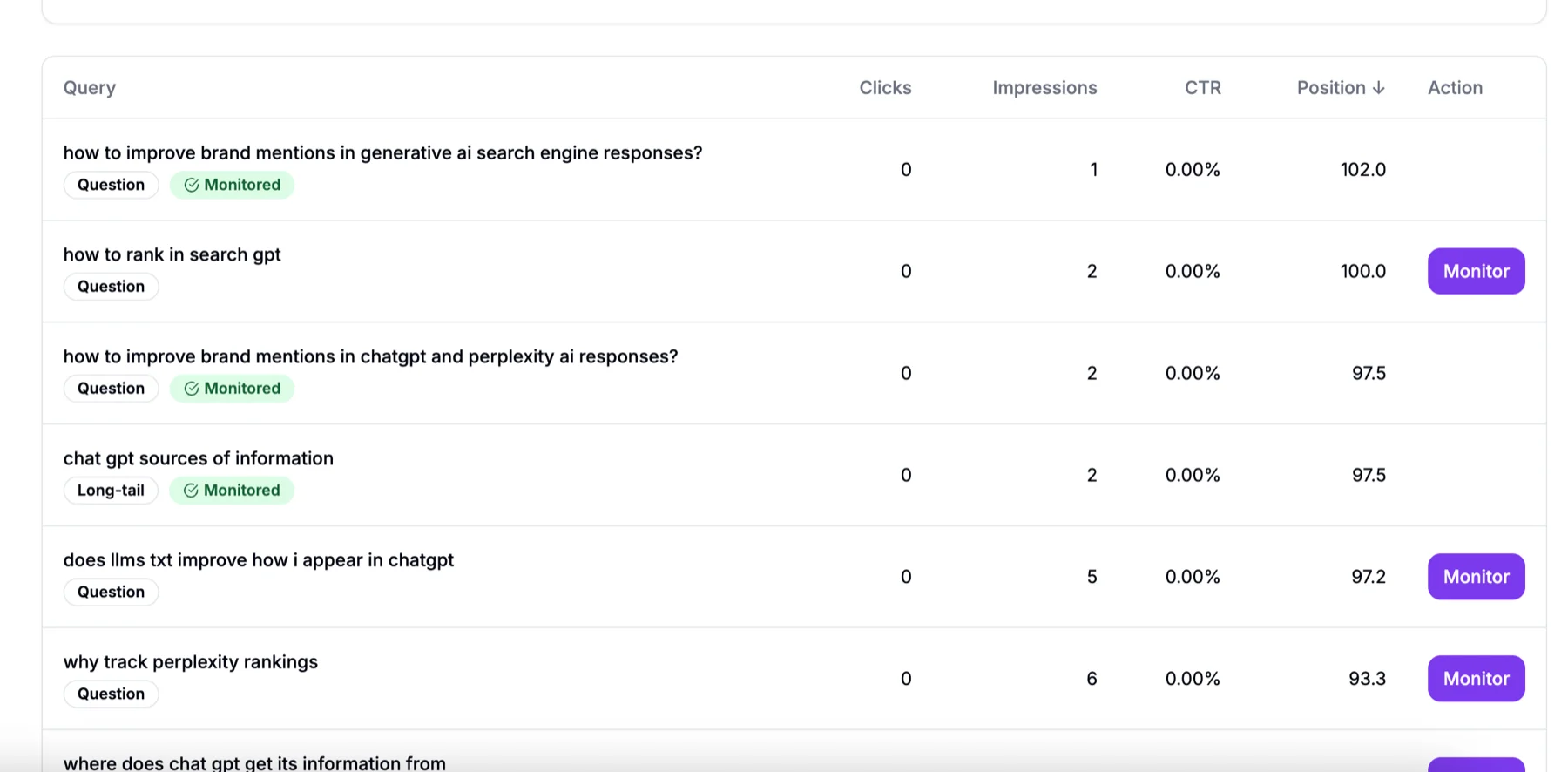
Connect your GSC in 60 seconds via OAuth. Qwairy then:
- Classifies every query by intent type and AI potential score
- Surfaces long-tail opportunities with conversational patterns
- Identifies competitive gaps where competitors appear in AI responses but you don't
- Enables one-click monitoring across ChatGPT, Perplexity, Claude, and AI Overview
No regex. No spreadsheets. No manual cross-referencing.
Key Takeaways
-
Informational and comparison queries first - these intent types trigger the detailed responses AI platforms are built to provide
-
Long-tail = high AI potential - 4+ word queries mirror conversational AI interactions, even if their traditional CTR is lower
-
AI Overview queries are validated targets - if Google triggers an AI response, ChatGPT and Perplexity likely will too
-
Your GSC data is underutilized - most teams analyze it for SEO only, missing the GEO goldmine sitting in their dashboard
What's Next
Finding prompts is step one. To actually gain AI visibility:
- Audit existing content - do you already rank for these queries?
- Identify gaps - where do competitors appear but you don't?
- Optimize for citation - structure content so AI platforms can extract and cite it (E-E-A-T guide)
- Monitor and iterate - track your brand mentions across AI platforms
Your GSC data is the starting point. The queries are already there - validated by real user behavior. The question is whether you'll use them.
Connect your GSC to Qwairy and surface AI-relevant prompts in 60 seconds.
Is Your Brand Visible in AI Search?
Track your mentions across ChatGPT, Claude, Perplexity and all major AI platforms. Join 1,500+ brands monitoring their AI presence in real-time.
Free trial • No credit card required • Complete platform access
Other Articles
How to Track AI Traffic in Google Analytics 4
Set up GA4 to measure visitors from ChatGPT, Perplexity, Claude and other AI platforms. Includes referrer patterns, regex filters, and traffic quality analysis.
The Fastest Way to Get Mentioned in LLMs in 2026
Speed-first framework to get cited by ChatGPT, Perplexity, and Claude. Based on 950K AI citations and 102K query analysis. Actionable tactics with timeline.